
The Carbon Capture Challenge We've Been Waiting to Solve
For years, direct air capture (DAC) technology has represented humanity's most ambitious climate solution—a way to literally pull carbon dioxide straight from the atmosphere and lock it away. Yet despite its promise, the technology has remained frustratingly expensive and energy-intensive, making large-scale deployment seem like a distant dream. At roughly $600 per ton of CO2 removed, traditional DAC methods have been economically prohibitive for most applications.
That calculus may be about to change. Researchers at the University of Helsinki have developed a superbase-alcohol compound that cuts CO2 capture costs by 50%—potentially bringing the price down to $250-300 per ton. This isn't merely an incremental improvement; it's a fundamental shift in the economics of negative emissions technology.
How the Helsinki Innovation Works
To understand why this breakthrough matters, we need to grasp what makes current DAC technology so energy-intensive. Traditional methods rely on solid sorbents that bind CO2 at ambient conditions but require extreme heat—often exceeding 900°C—to release the captured carbon. This energy demand becomes the primary cost driver, making the entire process economically challenging at scale.
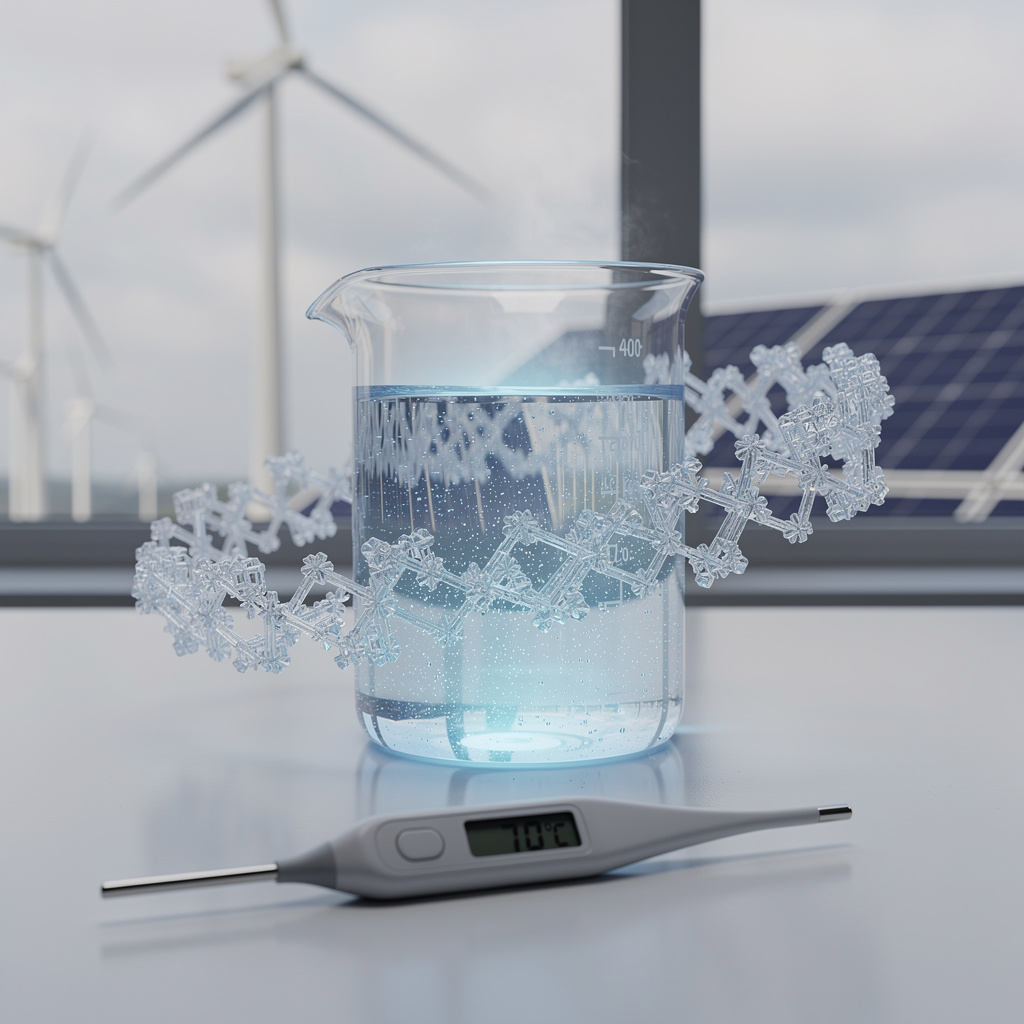
The Helsinki team's approach is elegantly different. They've developed a liquid sorbent composed of a superbase (a strong, non-nucleophilic base) combined with alcohol. This compound selectively captures CO2 directly from ambient air under normal conditions, but here's the critical advantage: it releases the captured carbon at remarkably mild temperatures—just 70°C.
To put this in perspective, 70°C is barely hot enough to make coffee. This dramatic reduction in energy requirements represents the core innovation. Instead of needing industrial furnaces operating at extreme temperatures, the system can potentially be powered by waste heat or renewable energy sources, fundamentally altering the energy economics of carbon capture.
The compound's performance metrics are equally impressive. One gram of this material can absorb 156 units of CO2 while maintaining selectivity—meaning it avoids unwanted reactions with other atmospheric gases. This selectivity is crucial because it ensures the system doesn't waste energy capturing and processing non-target molecules.
Why This Matters for Climate Goals
The implications of this cost reduction extend far beyond academic interest. Climate scientists have long identified a critical gap in our emissions reduction toolkit: we cannot eliminate all emissions through renewable energy and efficiency improvements alone. Some sectors—such as cement production, aviation, and heavy industry—will inevitably produce CO2 that's difficult or impossible to prevent at the source.
Direct air capture fills this gap, but only if it becomes economically viable. At $600 per ton, DAC was essentially a luxury technology—something we might deploy in small quantities for carbon offset programs or niche applications. At $250-300 per ton, the technology enters a fundamentally different economic category. Suddenly, it becomes competitive with other climate solutions and potentially profitable when combined with carbon pricing mechanisms.
Consider the broader context: the European Union's carbon pricing has reached €80 or more per ton in recent years, and many analysts expect carbon prices to continue rising. At these price points, DAC becomes not just viable but economically attractive. Organizations could capture carbon, sell it to industrial users, or benefit from carbon credit mechanisms—creating a genuine market rather than relying on subsidies.
The Path to Scalability
What makes the Helsinki innovation particularly significant is its focus on recyclability and efficiency. The compound can be regenerated repeatedly, reducing the material costs associated with single-use sorbents. This aligns perfectly with the scaling challenges that have plagued previous DAC attempts.
We're already seeing major players recognize DAC's potential. Climeworks operates the Orca plant in Iceland, currently the world's largest DAC facility, capturing approximately 4,000 tons of CO2 annually. Occidental Petroleum is planning STRATOS, an even larger facility. These projects are valuable proving grounds, but they operate at costs that rely heavily on subsidies and carbon credits.
The Helsinki breakthrough could be the catalyst that transforms these pilot projects into economically self-sustaining operations. If the cost reduction holds at scale—and research suggests the chemistry is sound—we could see a wave of DAC facility development globally. Finland itself is positioned to become a hub for this technology, leveraging abundant renewable energy and existing cleantech expertise.
Looking Beyond the Laboratory
Of course, moving from laboratory success to industrial-scale deployment involves challenges beyond the chemistry. The team will need to demonstrate that the compound maintains performance through thousands of capture-release cycles. They'll need to prove that the system works reliably in various climates and atmospheric conditions. Integration with industrial processes and energy systems will require careful engineering.
Yet these are engineering challenges rather than fundamental scientific obstacles. The core innovation—a low-temperature, selective CO2 capture system—is proven. The path forward, while demanding, is clear.
The broader implications extend to energy systems themselves. If DAC becomes cost-effective enough, it could enable carbon-negative energy production. Renewable electricity could power DAC systems to remove CO2, which could then be combined with hydrogen to create synthetic fuels. This creates a closed-loop system where renewable energy drives negative emissions while producing usable fuel.
The Convergence of Solutions
No single technology will solve climate change. We need aggressive emissions reductions across energy, transportation, agriculture, and industry. But we also need negative emissions technologies to address the residual emissions we cannot eliminate and to help restore atmospheric carbon to safer levels.
The Helsinki team's innovation represents a crucial step toward making negative emissions economically rational rather than merely idealistic. When you can capture carbon for $250-300 per ton, and carbon is priced at €80 or more per ton, the math becomes compelling. Investors, corporations, and governments can all see a path to profitability and climate benefit simultaneously.
Conclusion: A Pivotal Moment for Carbon Removal
The University of Helsinki's superbase-alcohol compound represents more than just an incremental improvement in carbon capture technology. It's a potential inflection point—the moment when direct air capture transitions from an aspirational climate solution to an economically viable one.
The 50% cost reduction is significant, but the real breakthrough is the shift from high-temperature, energy-intensive processes to low-temperature, recyclable systems. This opens the door to integration with renewable energy, waste heat recovery, and distributed deployment.
As we face the reality that emissions reductions alone won't be sufficient to meet climate targets, technologies like this become increasingly essential. The Helsinki innovation doesn't solve climate change—but it removes one of the major economic barriers preventing us from deploying negative emissions at scale. In the race against climate change, that's a victory worth celebrating, and a signal that solutions once thought impossible are becoming within reach.