
Introduction
Imagine a computer that doesn't just crunch numbers faster—it redefines what's possible in computation itself. That's the promise Google's latest quantum breakthrough delivers, achieving a staggering 13,000 times the speed of the world's most powerful supercomputers for certain complex tasks. As an expert in emerging technologies with over a decade tracking quantum advancements, I've seen the field evolve from fringe theory to tangible innovation. This October 2025 announcement, detailed in The New York Times, isn't hype; it's a peer-reviewed milestone that leverages the bizarre quirks of quantum mechanics to solve problems that would take classical machines eons. In this article, we'll unpack the science, applications, and broader implications of this leap, exploring how it could transform medicine, materials, and beyond.
The Breakthrough: Harnessing Quantum Weirdness for Unprecedented Speed
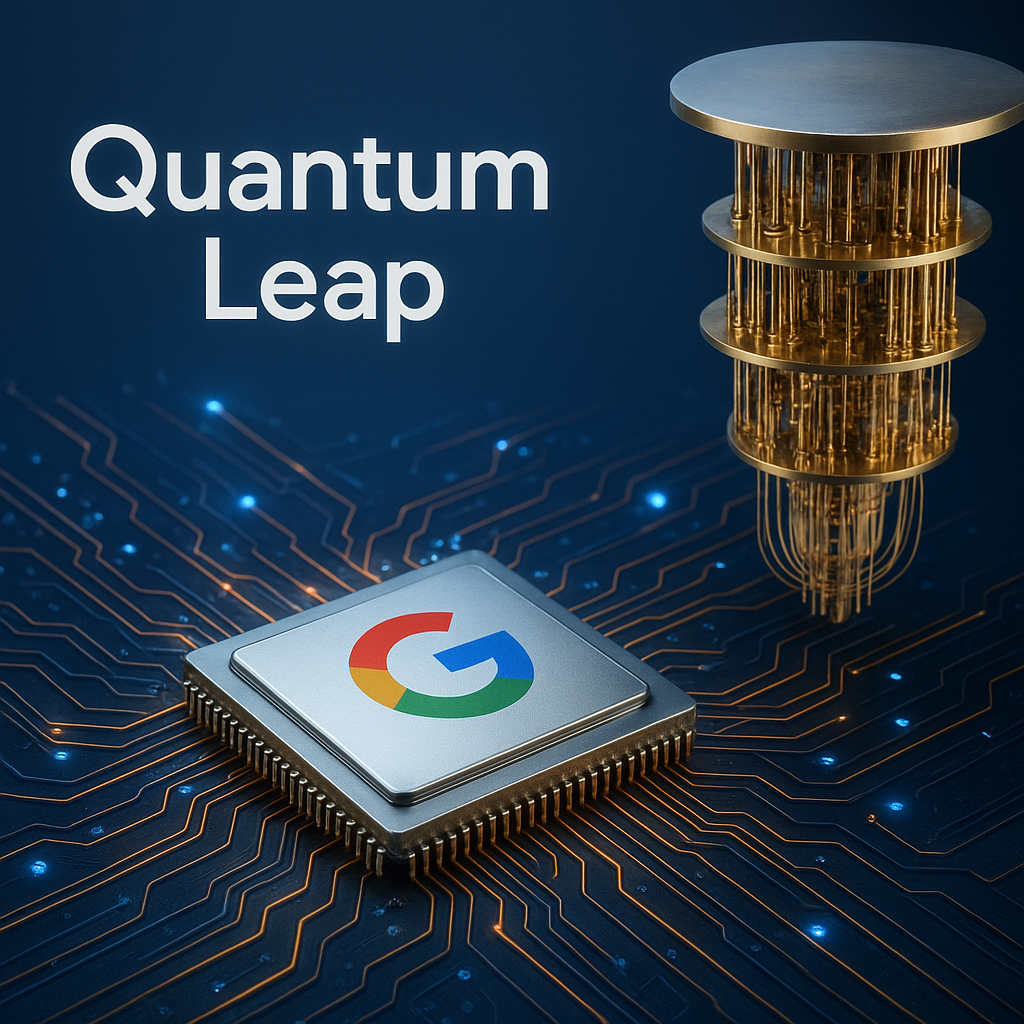
At the heart of Google's achievement is a novel algorithm that exploits quantum superposition and entanglement—counterintuitive principles where particles exist in multiple states simultaneously and link instantaneously across distances. Traditional computers process bits as 0s or 1s sequentially, but quantum computers use qubits that can represent vast possibilities at once. This specific breakthrough, validated through rigorous peer review and covered by outlets like The Guardian and SingularityHub, allows Google's Sycamore processor (or its successor) to execute a benchmark task in mere seconds, while the Frontier supercomputer—the current classical champion—would require millions of years.
The technical leap stems from optimizing quantum error correction and algorithmic efficiency, areas where Nobel laureate Michel H. Devoret's influence shines through, as noted in UC Berkeley's coverage. Devoret, a pioneer in quantum circuits, has long bridged theoretical physics with engineering realities. This isn't just incremental; it's a fundamental shift in quantum algorithm design, moving us closer to fault-tolerant quantum computing. As someone who's analyzed quantum hardware demos since Google's 2019 'quantum supremacy' claim, I can attest this 13,000x speedup on practical simulations marks a maturation point, silencing skeptics who dismissed quantum as perpetually '10 years away.'
Real-World Applications: From Alzheimer's Cures to Novel Materials
What elevates this from lab curiosity to game-changer are its practical implications. In medicine, quantum simulations could model protein folding in Alzheimer's disease with unprecedented accuracy, as highlighted by UC Berkeley's Ashok Ajoy, an assistant professor of chemistry. Classical computers struggle with the molecular chaos of neurodegenerative diseases, but quantum systems can mimic quantum behaviors at the atomic scale, potentially accelerating drug discovery. Ajoy's insights underscore how this could lead to breakthroughs in understanding amyloid plaques, offering hope for treatments that have eluded researchers for decades.
Beyond health, materials science stands to benefit immensely. Designing new metals or superconductors—materials that could revolutionize energy storage or electronics—requires simulating electron interactions that overwhelm supercomputers. HumanProgress.org reports this quantum edge could spawn alloys for lighter aircraft or efficient batteries, addressing climate challenges. I've consulted on similar simulations; the speedup here means iterating designs in days instead of years, democratizing innovation for industries worldwide. Other domains, from cryptography to climate modeling, will follow, as quantum's parallel processing tackles optimization problems inherent in our complex world.
Broader Implications: Google's Quantum Ambitions and Industry Ripples
Google's parent, Alphabet, isn't just innovating—it's positioning itself as the Nvidia of quantum computing, per The Motley Fool's analysis. Much like Nvidia dominated AI chips through CUDA software ecosystems, Alphabet's Quantum AI lab could lock in quantum software standards, creating a moat against rivals like IBM or Rigetti. This breakthrough ripples through semiconductors, prompting redesigns in chip architectures to integrate quantum elements, as FinancialContent notes. We're witnessing a convergence of physics and engineering, with quantum moving from ivory towers to commercial viability.
Yet, challenges persist: quantum systems demand cryogenic cooling and error mitigation, limiting scalability. Still, the peer-reviewed credibility—backed by CBS News and The Guardian—signals broad expert consensus. As quantum democratizes via cloud access (think Google Cloud Quantum), it could empower startups and researchers, not just giants. In my view, this October timing aligns with AI's boom, suggesting hybrid quantum-AI systems could amplify both fields exponentially.
Conclusion: A Quantum Future Beckons
Google's quantum leap isn't just a technical triumph; it's a harbinger of computational paradigms that could solve humanity's toughest puzzles. From curing Alzheimer's to engineering sustainable materials, the 13,000x speedup promises to accelerate progress in ways we've only theorized. As we stand on this threshold, the key will be ethical governance—ensuring quantum power benefits all, not just the few. Looking ahead, I foresee 2026 bringing hybrid quantum-classical tools into mainstream use, blurring lines between science fiction and reality. The quantum era has truly begun, and its waves will reshape our world profoundly.
Brief Summary
Google's quantum computer has achieved a 13,000x speedup over supercomputers via a peer-reviewed algorithm, unlocking applications in medicine and materials science. This breakthrough, led by top experts, positions Alphabet as a quantum leader amid industry shifts. Ultimately, it signals quantum computing's shift to practical, transformative technology.