
Houston's Biotech Revolution: How Strategic Collaboration Is Reshaping Medicine
For decades, the biotech industry has been dominated by a handful of coastal powerhouses—Boston's Kendall Square, San Francisco's Mission Bay, and San Diego's Torrey Pines. But a seismic shift is underway in Houston, where world-class research institutions are converging to establish what could become the nation's next major innovation epicenter. The inaugural Biotech Innovation Symposium, held at the Texas Medical Center's Helix Park, signals a turning point in this transformation—one that promises to reshape how biomedical research is conducted and commercialized.
A Convergence of Excellence
When Rice University, Baylor College of Medicine, and Houston Methodist gathered at Helix Park for the inaugural Biotech Innovation Symposium, they were orchestrating far more than a typical academic conference. They were executing a deliberate, strategic alignment of three powerhouse institutions, each bringing distinct strengths to Houston's emerging biotech ecosystem.
Rice University's Department of Bioengineering is recognized as one of the nation's premier programs, combining engineering rigor with biological insight. The faculty and students who participated in the symposium represent the cutting edge of biomedical innovation—researchers working at the intersection of synthetic biology, tissue engineering, and computational medicine. Their involvement was central to the event's mission of showcasing Houston's capacity for breakthrough research.
Baylor College of Medicine, with its world-renowned clinical programs and research infrastructure, brings decades of translational medicine expertise. Houston Methodist, one of the nation's leading health systems, contributes real-world clinical networks and patient populations essential for testing and validating new therapeutic approaches. Together, these institutions create a rare ecosystem where fundamental research, clinical translation, and patient care operate in seamless proximity.
Helix Park: The Physical Manifestation of Collaboration
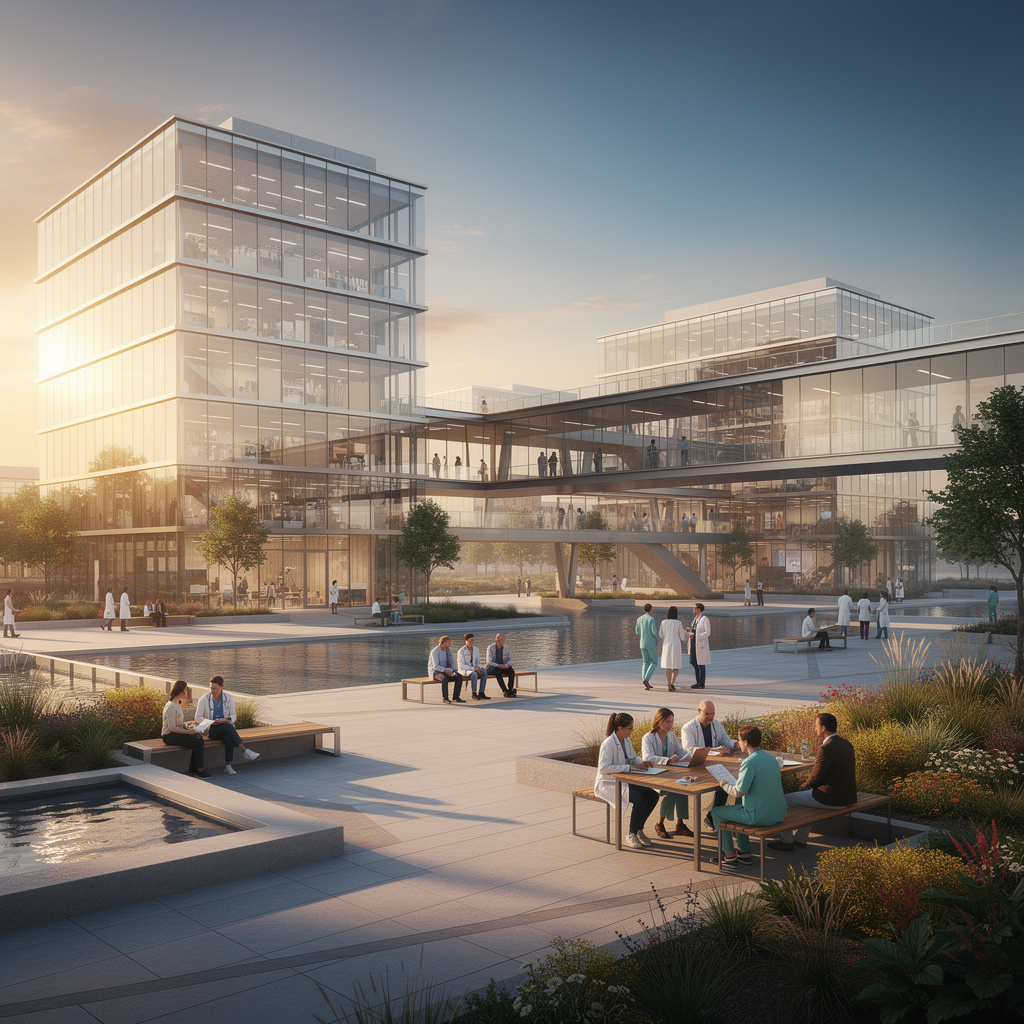
The choice of venue is profoundly significant. Helix Park, a 1.6 million-square-foot innovation district within the Texas Medical Center, represents a deliberate architectural and organizational strategy to accelerate discovery. Rather than scattering institutions across a sprawling metropolis, Helix Park concentrates research talent, clinical expertise, and entrepreneurial infrastructure within walking distance.
This physical proximity is transformative. History demonstrates that innovation clusters thrive on serendipitous encounters and informal collaboration. When a bioengineering researcher can walk across a plaza to discuss a challenge with a clinical physician, who then connects with an entrepreneur launching a startup, the probability of breakthrough solutions increases exponentially.
Helix Park's design explicitly facilitates these interactions. With integrated laboratory spaces, collaborative work areas, housing for researchers and entrepreneurs, and green spaces for informal gathering, the district embodies a new model for biotech development. It transcends traditional laboratory infrastructure to create an environment where ideas cross-pollinate and mature rapidly.
Houston's Emergence as a Biotech Powerhouse
The Biotech Innovation Symposium arrives at a critical moment for Houston's biotech sector. The city has historically been defined by energy and petrochemicals, but a quiet revolution has been building within the Texas Medical Center and its surrounding innovation ecosystem.
The Texas Medical Center is the world's largest medical complex, encompassing over 60 institutions with unparalleled clinical expertise and research infrastructure. This existing foundation provides Houston with a distinct advantage many aspiring biotech hubs lack: integrated access to patient populations, clinical data, and healthcare delivery systems. When developing a new cancer therapy or cardiovascular treatment, proximity to world-class clinicians and relevant patient populations is invaluable.
Recent investments in the TMC3 expansion, which includes Helix Park's development, signal institutional and financial commitment to this vision. Funding for Rice's bioengineering initiatives, coupled with venture capital increasingly flowing into Houston biotech startups, suggests that investors recognize the city's potential. The symposium serves as a public declaration of this momentum—Houston is positioned to compete with established biotech hubs.
The Strategic Importance of Institutional Leadership
What distinguishes this symposium from typical academic conferences is the deliberate institutional leadership demonstrated by Rice University. By organizing and hosting the event, Rice positioned itself as a convener and thought leader in Houston's biotech ecosystem. This is strategically significant.
Universities increasingly recognize that their role extends beyond teaching and research to include ecosystem development. By bringing together Baylor College of Medicine and Houston Methodist, Rice demonstrated that biotech innovation in Houston is not about individual institutional success—it is about collective regional advancement. This collaborative posture, modeled at the leadership level, sets the tone for the entire ecosystem.
The participation of Rice's bioengineering faculty underscores another crucial point: biotech innovation requires the integration of engineering principles with biological understanding. Bioengineers invent new tools; they develop novel biomaterials, design bioreactors, create computational models, and engineer biological systems from first principles. In an era where precision medicine, gene therapy, and synthetic biology are reshaping healthcare, bioengineering expertise is indispensable.
Implications and Future Trajectory
The inaugural nature of this symposium suggests it will become a regular event, likely growing in scope and influence. If so, it could establish Houston's biotech identity in the minds of researchers, entrepreneurs, investors, and patients worldwide.
For early-stage biotech companies, this emerging ecosystem offers compelling advantages. Proximity to clinical partners accelerates the path from bench to bedside. Access to world-class engineering talent from Rice supports the technical innovation that differentiates successful biotech ventures. The existing healthcare infrastructure reduces barriers to clinical testing and validation.
For researchers, Houston increasingly offers what coastal hubs have provided for decades: a community of peers pushing the boundaries of what's possible, funding mechanisms to support ambitious projects, and a clear pathway to commercialize discoveries. The cost of living and doing business in Houston also provides financial advantages that extend research budgets and startup runways.
For patients, the implications are perhaps most profound. When biotech innovation accelerates, new treatments reach patients faster. When research institutions collaborate seamlessly, redundant efforts diminish and resources concentrate on the most promising approaches. When clinical systems integrate with research centers, the translation from discovery to therapy becomes more efficient.
Conclusion: The Emergence of a New Biotech Era
The inaugural Biotech Innovation Symposium at Helix Park represents far more than a single event. It embodies a strategic vision for Houston's future as a major biotech and life sciences hub. By bringing together Rice University's bioengineering excellence, Baylor College of Medicine's clinical and research prowess, and Houston Methodist's integrated health system capabilities, the symposium demonstrates that Houston possesses the fundamental ingredients for biotech success.
The convergence of world-class institutions, physical innovation infrastructure, substantial patient populations, and increasing investment creates conditions for transformative research and clinical breakthroughs. While Boston and San Francisco remain important biotech centers, Houston is now positioning itself as a serious competitor—one with distinct advantages in clinical integration, cost efficiency, and collaborative culture.
As this ecosystem matures, we can expect to see more biotech startups emerging from Houston research, more clinical trials conducted at Houston institutions, and more patients benefiting from therapies developed within this innovative community. The inaugural symposium marks not the beginning of Houston's biotech story, but rather a public acknowledgment of a transformation already underway—one that promises to reshape biomedical research and healthcare delivery for decades to come.
The question is no longer whether Houston can become a biotech hub. The question is how quickly and how far this momentum will take the city.