
How a Single Tweet Exposed China's Lead in Humanoid Robotics
When Elon Musk posted a single word—"Impressive"—on X alongside a video of Chinese humanoid robots executing synchronized backflips at a concert, he inadvertently signaled something far more significant than a casual endorsement. In the high-stakes world of artificial intelligence and robotics, such validation from one of the industry's most influential figures carries weight that extends well beyond social media engagement metrics. This moment represents a crucial inflection point in the global competition for humanoid robot dominance, one that reveals uncomfortable truths about where innovation is actually happening in 2025.
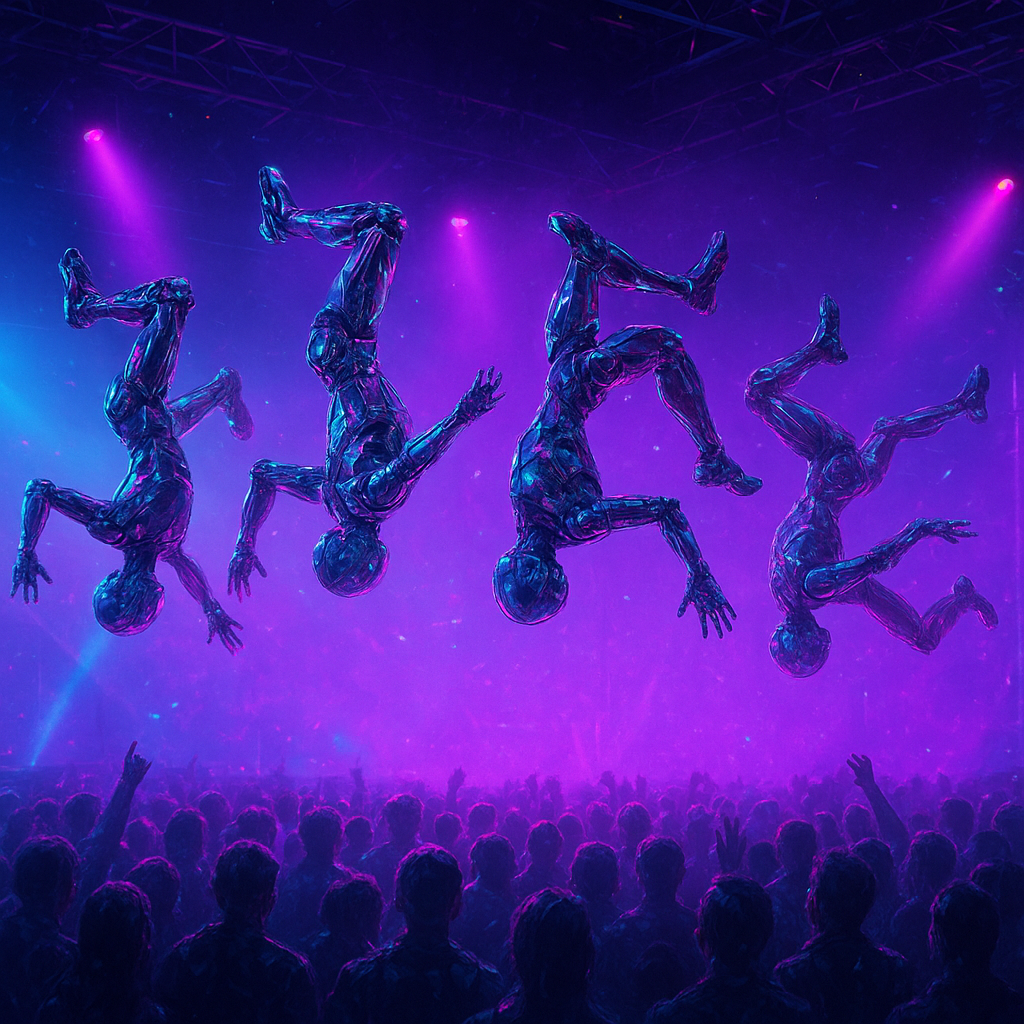
The performance took place on December 20, 2025, at Wang Leehom's concert in Chengdu, China, where six Unitree G1 humanoid robots executed a choreographed routine featuring perfectly synchronized backflips and dynamic movements. What might appear to casual observers as mere entertainment was, in fact, a public demonstration of motion control capabilities that rival or exceed anything currently deployed in Western laboratories. The viral spread of this video, amplified by Musk's rare public praise, has forced a reckoning within the robotics community about the competitive landscape and what it means for the future of the industry.
The Technical Achievement Behind the Performance
Executing a single backflip is difficult enough for a humanoid robot—it requires precise calculations of center of gravity, momentum transfer, and landing stability. Coordinating six robots to perform identical maneuvers in perfect synchronization elevates the difficulty exponentially. Each robot must account not only for its own biomechanics but also for spatial relationships with its peers, requiring sophisticated motion planning algorithms and real-time adjustment capabilities.
The Unitree G1, developed by Hangzhou-based Unitree Robotics, represents a significant leap forward in accessible humanoid robotics. Unlike many Western counterparts that remain confined to research facilities, the G1 has been designed with commercialization in mind. The robots demonstrated at the concert exhibited the kind of agility and responsiveness that typically requires years of refinement in controlled laboratory environments. The fact that Unitree chose to debut these capabilities in a live performance setting—rather than a carefully orchestrated product launch—suggests confidence in the platform's reliability that speaks volumes about the company's engineering maturity.
Musk's endorsement, coming from someone who has invested billions in Tesla's Optimus project and who rarely offers public validation to competitors, underscores the genuine technical merit of what was accomplished. This wasn't hyperbolic praise; it was recognition from someone with deep expertise in the field that a meaningful milestone had been reached.
The Geopolitical Implications of a Single Performance
Perhaps more important than the technical achievement is what this moment reveals about the broader robotics landscape. For years, Western observers have maintained that while China might lead in manufacturing and deployment at scale, the cutting edge of robotics innovation remained firmly rooted in Silicon Valley, Boston, and other traditional tech hubs. This performance challenges that narrative in ways that are difficult to dismiss.
China's approach to humanoid robotics has been fundamentally different from the West's. Where American companies have often prioritized theoretical advancement and sophisticated sensor arrays, Chinese manufacturers like Unitree have focused on practical functionality, cost-effectiveness, and real-world deployment. This isn't a judgment about which approach is superior—both have merit—but rather an observation about strategic priorities. The result is that China has achieved functional parity with Western systems while maintaining a significant cost advantage.
The concert performance serves as a powerful demonstration precisely because it showcases real-world applicability. These robots weren't performing in a sterile laboratory under controlled conditions; they were executing complex movements in a live environment with all its unpredictability and potential for failure. The fact that they succeeded flawlessly speaks to a level of robustness that investors, manufacturers, and potential customers find compelling.
Musk's repost amplifies this message across his massive social media following, effectively endorsing not just Unitree's technical capabilities but the broader narrative that China is now leading in certain aspects of humanoid robotics development and deployment. In an industry where perception often drives investment and talent acquisition, such an endorsement carries tangible consequences.
What This Means for the Future of Robotics
The viral success of this video will likely accelerate several trends already underway. First, we can expect increased investment in humanoid robotics applications beyond manufacturing and research. Entertainment, hospitality, and other service industries may now view humanoid robots as viable tools rather than distant possibilities. Unitree's demonstration essentially provided a proof-of-concept for robots operating in dynamic, unpredictable human environments.
Second, this moment will intensify competition between Chinese and Western robotics companies. Tesla's Optimus program, Boston Dynamics' Atlas, and other Western projects will face renewed scrutiny regarding their capabilities and timelines. The bar for impressive has been reset, and companies will need to demonstrate comparable or superior capabilities to maintain investor confidence and media attention.
Third, we're likely to see a shift in how humanoid robots are commercialized and marketed. Rather than waiting for perfect laboratory demonstrations, companies may increasingly opt for public performances that showcase real-world capabilities. This approach carries risks—public failures are highly visible—but the rewards in terms of credibility and market interest are substantial.
Finally, this performance underscores the importance of affordability and accessibility in driving robotics adoption. The Unitree G1 is significantly less expensive than many comparable Western systems, which means it's more likely to find its way into diverse applications and markets. As more robots enter the field and accumulate real-world operational data, the pace of improvement will accelerate, creating a virtuous cycle that benefits the leader in deployment volume.
Conclusion: A Moment of Transition
Elon Musk's single-word endorsement might seem like a small gesture, but it represents something larger: a recognition that the center of gravity in humanoid robotics is shifting. This doesn't necessarily mean that Western companies have fallen behind irreversibly—innovation remains distributed globally—but it does mean that the comfortable assumption of Western technological superiority in this domain can no longer be taken for granted.
The Unitree G1 robots performing at Wang Leehom's concert were more than entertainment; they were a message. The message is that practical, deployable humanoid robotics are no longer a distant future prospect. They're here, they're affordable, they're reliable, and they're increasingly capable of operating in complex real-world environments. As we move forward, the question won't be whether humanoid robots will transform industries and society—that outcome seems increasingly inevitable—but rather who will lead that transformation and who will follow.
For investors, entrepreneurs, and policymakers watching this space, Musk's "Impressive" might well be remembered as the moment when the humanoid robotics race entered a new phase, one defined not by promises of future capabilities but by demonstrated real-world performance. In that context, Unitree's concert performance wasn't just impressive—it was a watershed moment.