
Introduction
As an expert in emerging computing technologies with over a decade tracking the intersection of quantum mechanics and high-performance computing, I've witnessed the quantum revolution evolve from theoretical promise to tangible prototypes. Yet, one persistent challenge has loomed large: quantum processors, or QPUs, are powerful but fragile, requiring robust classical computing to handle error correction, optimization, and real-world data crunching. Enter NVIDIA's groundbreaking announcement of NVQLink™, an open system architecture unveiled at the GTC conference in Washington, D.C. This isn't just another hardware tweak—it's a pivotal bridge between the probabilistic world of quantum bits and the deterministic muscle of GPU supercomputing. With commitments from 17 QPU builders, five controller makers, and nine U.S. national laboratories, NVQLink signals a maturing ecosystem poised to accelerate hybrid quantum applications. In this article, I'll unpack what NVQLink means, its technical underpinnings, and why it could redefine computational frontiers.
The Core of NVQLink: Bridging Quantum and Classical Worlds
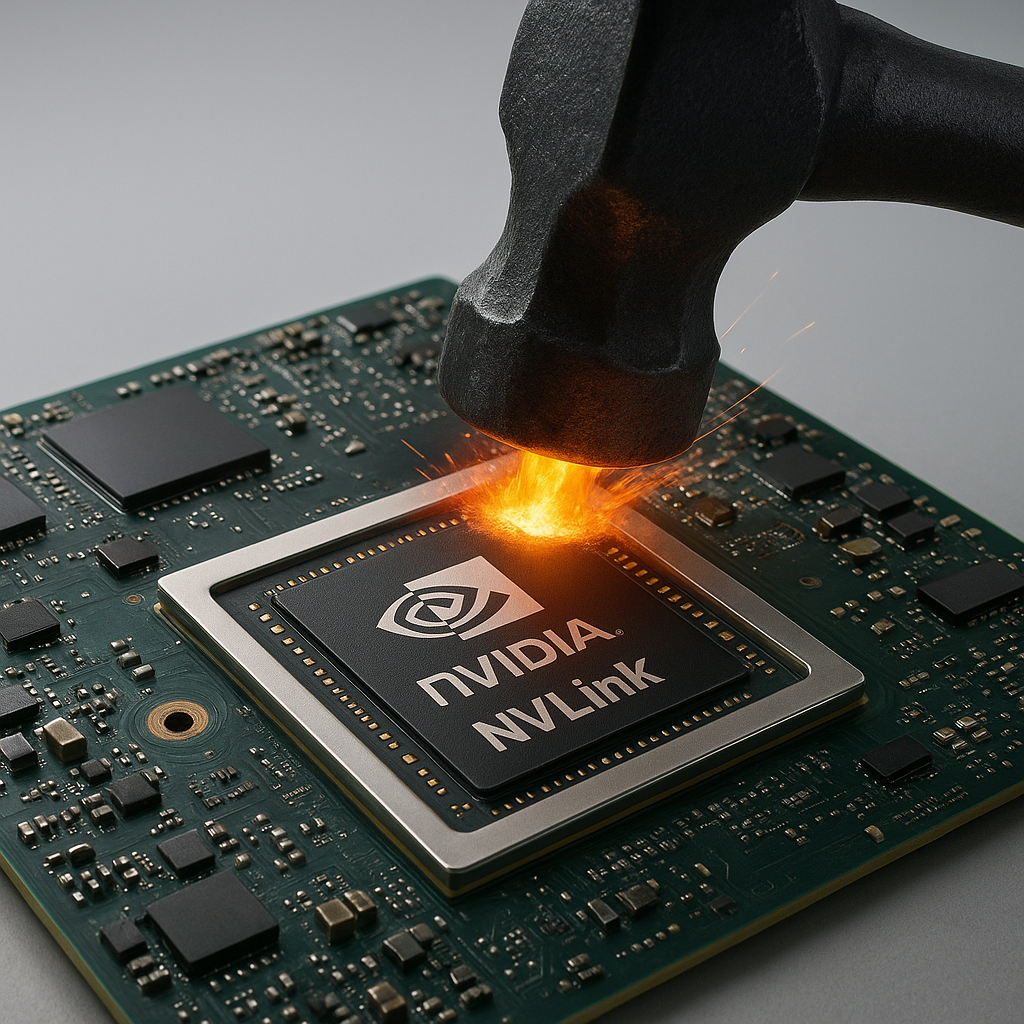
At its heart, NVQLink is designed to tightly couple the extreme performance of NVIDIA's GPUs with quantum processors, enabling seamless data flow and computation sharing between these disparate paradigms. Drawing from NVIDIA's newsroom release, NVQLink integrates directly with the CUDA-Q platform, NVIDIA's open-source quantum-classical computing framework. This isn't a loose affiliation; it's a high-bandwidth interconnect that allows QPUs to offload classical tasks to GPUs in real-time, minimizing latency and maximizing efficiency.
From my experience analyzing hybrid systems, this architecture addresses a critical bottleneck in quantum computing: noise and error rates. Quantum systems are inherently error-prone due to decoherence, where qubits lose their delicate quantum states. NVQLink facilitates advanced error-correction algorithms running on GPUs, which can process vast datasets far faster than traditional CPUs. For instance, imagine a quantum simulation for drug discovery— the QPU explores molecular configurations quantumly, while GPUs handle the heavy lifting of validating results against classical models. The open nature of NVQLink is equally compelling; it avoids vendor lock-in by supporting multiple QPU hardware from builders like IonQ, Rigetti, and Quantinuum, fostering interoperability that's been a holy grail in the field.
This integration isn't happening in a vacuum. As reported by HPCwire, NVQLink leverages NVIDIA's battle-tested NVLink technology—familiar from AI supercomputers like those powering ChatGPT training—but adapts it for quantum scales. With bandwidths potentially exceeding 1 TB/s per link (based on NVLink precedents), it ensures that quantum outputs feed directly into GPU pipelines without the slowdowns that plague current hybrid setups using slower Ethernet or InfiniBand connections.
Industry Momentum and Ecosystem Support
What truly elevates NVQLink is its rapid adoption, underscoring a consensus that hybrid computing is no longer optional but essential. NVIDIA has already secured pledges from 17 leading QPU builders, including heavyweights in the quantum space, alongside five controller specialists who manage QPU operations. Even more telling is the involvement of nine U.S. national laboratories, such as Argonne and Oak Ridge, which are at the forefront of scientific computing. These labs aren't jumping on bandwagons; their commitment, as highlighted in Stock Titan's coverage, reflects rigorous validation through pilot integrations.
In my view, this broad support validates NVQLink as a de facto standard. Proprietary quantum systems have fragmented the market, but an open architecture like this encourages collaboration. TechPowerUp notes that this could standardize interfaces for quantum hardware, much like USB did for peripherals, accelerating commercialization. For researchers and developers, it means less time wrestling with incompatible stacks and more focus on innovation. StreetInsider reports emphasize how NVQLink extends CUDA-Q's software ecosystem, providing tools for programming hybrid workflows in familiar languages like Python or C++.
Government backing adds another layer. The participation of national labs suggests strategic importance, potentially influencing funding from agencies like the Department of Energy. In an era of quantum supremacy races with China and Europe, NVQLink positions the U.S. as a leader in scalable quantum tech, blending NVIDIA's GPU dominance with quantum's disruptive potential.
Implications for Science, Industry, and Beyond
The ripple effects of NVQLink extend far beyond hardware specs. For scientific labs, it democratizes access to hybrid computing, enabling breakthroughs in fields like materials science, climate modeling, and cryptography. Picture optimizing fusion energy reactors: QPUs could simulate plasma behaviors quantumly, with GPUs refining classical approximations for practical engineering. This hybrid approach is crucial because no pure quantum computer exists yet that's fault-tolerant at scale—estimates suggest we need millions of qubits, versus today's hundreds.
Industrially, NVQLink bolsters NVIDIA's moat in a burgeoning market projected to hit $65 billion by 2030, per McKinsey. By becoming the infrastructure backbone, much like in AI, NVIDIA could capture value across the stack—from chips to cloud services. For startups and enterprises, the open ecosystem lowers barriers; a quantum builder can now plug into NVIDIA's Grace Hopper superchips without reinventing the wheel.
Challenges remain, of course. Quantum tech's cryogenic requirements and power demands will test integration limits, and scalability hinges on error rates dropping below 0.1%. Yet, as an observer of these evolutions, I see NVQLink as a catalyst, shifting quantum from lab curiosity to production tool.
Conclusion: A Quantum Leap Toward Practical Hybrid Computing
NVIDIA's NVQLink isn't just an announcement—it's a manifesto for the hybrid era, where quantum's exotic power amplifies classical might. By fostering an open, supported ecosystem, it paves the way for applications that solve intractable problems, from personalized medicine to secure communications. Looking ahead, expect NVQLink to spur a wave of innovations, standardizing quantum interfaces and drawing more players into the fold. As we stand on this cusp, the fusion of quantum and GPU computing promises not just faster calculations, but a reimagining of what's computationally possible. The quantum future feels closer than ever, and NVIDIA is leading the charge.
Brief Summary
NVIDIA's NVQLink bridges quantum processors and GPUs through an open architecture, backed by 17 QPU builders and nine U.S. labs, integrating with CUDA-Q for hybrid computing. This move addresses key challenges in error correction and scalability, positioning NVIDIA as a quantum infrastructure leader. It signals a shift toward practical quantum applications in science and industry.