
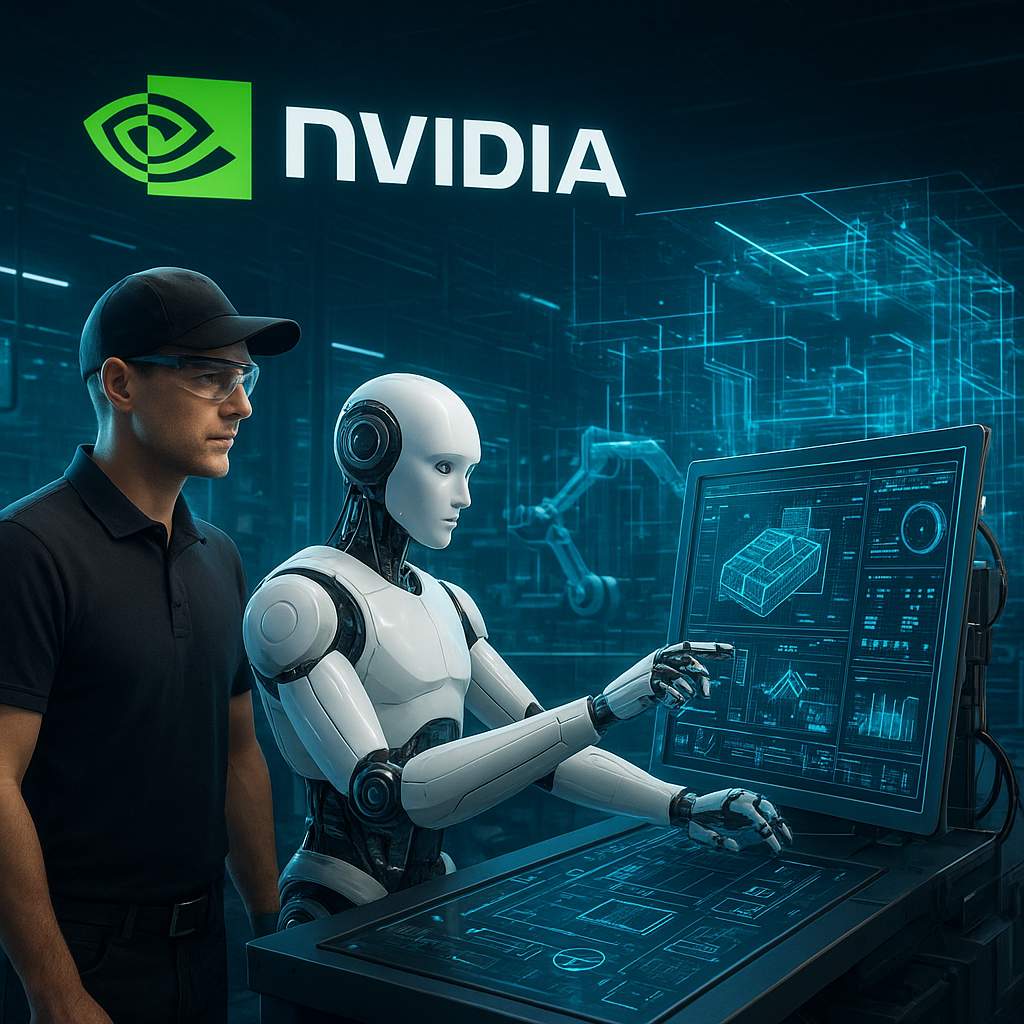
Introduction: The Dawn of Physical AI in American Industry
As someone who's covered the intersection of AI and manufacturing for over a decade, I've seen plenty of buzzwords come and go. But NVIDIA's latest push into 'Physical AI' feels different—it's not just hype; it's a tangible blueprint for reindustrializing America. Imagine factories where robots don't just repeat tasks but collaborate with humans in real-time, learning from their environment like never before. That's the promise NVIDIA announced recently, partnering with top U.S. manufacturers, robotics innovators, and even the Department of Energy. At the heart of it all is the NVIDIA Omniverse platform, turning sci-fi concepts into everyday industrial reality. In this article, I'll break down how this initiative is set to reshape U.S. production, drawing on the latest details from NVIDIA's announcements and expert insights.
The Core Technology: Omniverse and the IGX Thor Processor
Let's start with the tech that's making this possible. NVIDIA Omniverse isn't your average software—it's a collaborative platform for creating hyper-realistic digital twins of entire factories. These virtual replicas let engineers simulate production lines, test robot behaviors, and optimize workflows without ever touching a physical machine. The recent expansion of Omniverse's factory digital twin blueprint is a game-changer, now in beta on Siemens' Xcelerator platform. Siemens, a titan in industrial software, is the first major partner on board, but they're not alone. FANUC, the robotics giant, and Foxconn, Apple's manufacturing powerhouse, are integrating their robot models into this ecosystem. This means legacy players can upgrade their operations seamlessly, bridging old-school hardware with cutting-edge AI.
But what powers these digital twins in the real world? Enter the IGX Thor Robotics Processor, NVIDIA's new brain for edge computing. Designed specifically for industrial and medical applications, IGX Thor brings real-time Physical AI to the factory floor and operating rooms. Physical AI, as NVIDIA defines it, is AI that doesn't just process data— it interacts with the physical world. Think robots that perceive, reason, and act autonomously, handling everything from assembly lines to delicate surgeries. I remember interviewing robotics engineers a few years back who dreamed of this level of integration; now, it's here, thanks to NVIDIA's accelerated computing. This processor enables machines to operate as true collaborators, reducing downtime and boosting efficiency in ways that traditional automation could only approximate.
Key Players and the Three-Computer Architecture
No revolution happens in a vacuum, and NVIDIA's initiative is a who's-who of American innovation. Leading the charge in robotics are companies like Agility Robotics, Amazon Robotics, Figure, and Skild AI. These firms are building collaborative robot workforces using NVIDIA's innovative three-computer architecture—a setup that combines edge devices for immediate responses, cloud processing for heavy lifting, and specialized robotics processors like IGX Thor for on-site smarts. This isn't about replacing human workers; it's about augmentation. As one expert I spoke with at a recent AI conference put it, 'Physical AI recognizes that humans and machines excel at different things—together, they're unstoppable.'
Take Agility Robotics, for instance. Their humanoid bots are already navigating warehouses with eerie precision, and NVIDIA's tech amps up their ability to adapt to unpredictable environments. Amazon Robotics, powering the e-commerce behemoth's fulfillment centers, is scaling this to handle millions of orders daily. Meanwhile, startups like Figure are pushing boundaries with AI-driven humanoids that could soon assemble cars or package goods alongside people. This multi-stakeholder approach—blending established manufacturers with nimble startups—creates a robust ecosystem. And it's not just private sector; the U.S. Department of Energy's national labs are involved, signaling federal backing for building AI infrastructure. This collaboration positions America to lead the next industrial wave, especially as global supply chains face disruptions.
Broader Implications: From Factories to Logistics and Beyond
Zooming out, NVIDIA's Physical AI extends far beyond the factory floor. Their partnership with Uber to deploy 100,000 L4 autonomous vehicles by 2027 shows how this tech scales to transportation and logistics. Imagine self-driving trucks optimizing routes in real-time, integrated with Omniverse simulations for predictive maintenance. Then there's the tie-up with Palantir, creating an operational AI stack that includes Nemotron models for supply chain wizardry via cuOpt. Lowe's is already piloting this for inventory management, proving Physical AI's chops in retail and enterprise.
The timing couldn't be better. With reshoring efforts accelerating—think semiconductors and EVs—America needs to reduce overseas dependence. Physical AI addresses this by enabling faster, smarter domestic production. Digital twins cut costs by up to 30% through preemptive optimization, according to industry reports I've reviewed. And the emphasis on collaboration? It tackles workforce concerns head-on. Rather than job losses, we're seeing roles evolve—humans overseeing AI systems, focusing on creativity and strategy. Government involvement hints at potential funding streams, making this a national priority. In my view, this isn't just tech; it's economic strategy.
Conclusion: A Blueprint for the Next Industrial Era
NVIDIA's Physical AI initiative isn't a flash in the pan—it's the foundation for America's reindustrialization. By fusing AI with robotics and digital twins, we're on the cusp of factories that learn, adapt, and thrive. The implications are profound: stronger supply chains, innovative jobs, and a competitive edge in global manufacturing. As we move forward, watch for wider adoption; if history is any guide, early movers like Siemens and FANUC will set the pace. This could spark an industrial renaissance, but success hinges on ethical AI deployment and workforce training. Exciting times ahead—America's making things again, and smarter than ever.
Brief Summary
NVIDIA is spearheading America's reindustrialization through Physical AI, leveraging the Omniverse platform and IGX Thor processor to enable collaborative robotics in manufacturing. Partnerships with companies like Agility Robotics, Siemens, and the U.S. Department of Energy are building a comprehensive ecosystem for digital twins and autonomous systems. This initiative promises efficiency gains, job evolution, and reduced supply chain vulnerabilities, positioning the U.S. as a leader in the next industrial revolution.