
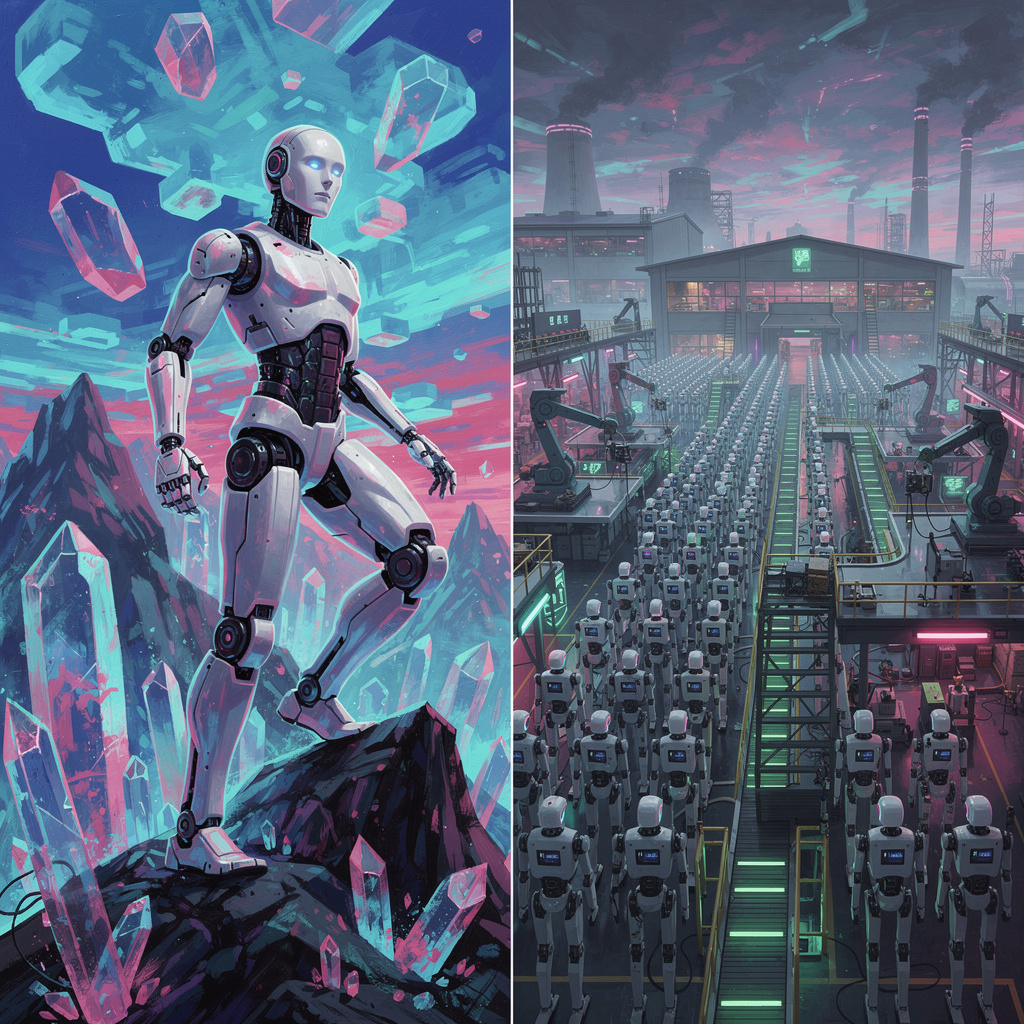
The Humanoid Robot Race: Why America's Innovation May Not Beat China's Scale
In the gleaming tech hubs of Suzhou, China, a quiet revolution is unfolding—one that could reshape the global economy far more dramatically than most observers realize. While Elon Musk captivates investors with promises of Tesla's Optimus humanoid robot revolutionizing human civilization, a more sobering reality is emerging: China may be positioned to dominate the very industry that America is pioneering.
This isn't science fiction. This is happening now, and the implications are profound.
The Great Humanoid Divide: Innovation vs. Scale
The humanoid robotics space presents a fascinating paradox. On one side, American companies—led by Tesla—are pursuing cutting-edge innovation to create robots capable of human-level proficiency. On the other side, Chinese manufacturers like Unitree are executing a fundamentally different strategy: flooding global markets with affordable, mass-produced humanoid units.
These aren't competing approaches so much as different bets on how the future will unfold. Tesla is betting that superior technology and performance will command premium prices and establish market dominance. China is betting that accessibility, affordability, and sheer volume will capture market share and establish manufacturing dominance.
Historically, we've seen this dynamic before. The question isn't whether both strategies have merit—they do. The question is which one prevails in a rapidly scaling market.
Musk himself has acknowledged this tension publicly. In recent months, he has told investors that while Tesla's Optimus will revolutionize the world and create a new mega-industry, most of that industry could belong to China. This candid assessment from one of America's most visionary entrepreneurs should give policymakers pause.
China's Manufacturing Advantage: The Flood Strategy
China's approach to humanoid robotics reflects decades of experience in manufacturing at scale. Companies like Unitree aren't attempting to build the most sophisticated robot—at least not yet. They're building robots that are "good enough" and then producing them in volumes unprecedented in Western markets.
This strategy offers several significant advantages:
Cost Efficiency: By leveraging existing supply chains and manufacturing expertise, Chinese producers can offer humanoid robots at price points that make them accessible to small businesses, manufacturers, and consumers. This dramatically expands the addressable market.
Market Saturation: High-volume production enables rapid market penetration. As more robots enter the market, they become normalized in industrial and commercial settings, accelerating adoption rates.
Feedback Loops: With millions of units deployed, Chinese manufacturers gain real-world data at a scale that American competitors cannot match. This accelerates improvement cycles and enables rapid iteration.
Supply Chain Control: China's dominance in component manufacturing—from semiconductors to motors to sensors—gives Chinese robotics companies structural advantages in cost and availability that competitors struggle to match.
The result is a market dynamic where China isn't necessarily trying to beat America at innovation; it's trying to own the market before America's superior technology can achieve meaningful scale.
Tesla's Optimus: The Innovation Gamble
Tesla's approach represents the American playbook: develop superior technology, achieve human-level performance, and command the market through excellence. The company has invested approximately $20 billion in robotics development, with Musk projecting that Optimus could reach human-level proficiency by 2026.
If this timeline holds, it would be genuinely transformative. A humanoid robot capable of performing complex human tasks would represent a fundamental shift in manufacturing, logistics, healthcare, and dozens of other industries. The economic implications are staggering—potentially creating what Musk describes as a "new mega-industry."
However, a critical bottleneck exists: production capacity. Even if Tesla successfully develops a revolutionary robot by 2026, ramping production to meaningful scale requires time. In the interim, Chinese manufacturers will have already established supply chains, trained workforces, built brand recognition, and captured significant market share with their more affordable alternatives.
It's the classic innovator's dilemma: being first to market with superior technology doesn't guarantee market dominance if competitors can scale faster and capture the majority of customers before you reach production parity.
The Policy Response: Is It Enough?
The U.S. government is not sitting idle. The White House is reportedly preparing an executive order to accelerate American robotics development, signaling that policymakers recognize the strategic importance of this competition.
However, critics raise valid concerns: policy interventions may not overcome the structural advantages China has built. Government support is valuable, but it cannot replicate the manufacturing ecosystem, supply chain integration, and cost advantages that Chinese competitors have cultivated over decades.
This raises uncomfortable questions: Can an executive order overcome the physics of global manufacturing? Can subsidies and incentives match the efficiency of established supply chains? Can policy move fast enough to matter in a technology race measured in years?
These aren't rhetorical questions—they're strategic ones that will determine whether American companies can compete effectively in the humanoid robotics market.
The Broader Implications
What makes this competition particularly significant is what's at stake. Humanoid robots aren't just another consumer gadget or industrial tool. They represent a fundamental shift in labor economics, manufacturing productivity, and geopolitical power. The nation that dominates humanoid robotics will have outsized influence over how automation reshapes the global economy.
If China captures the majority of the humanoid robotics market, it won't just be an economic loss for American companies—it will represent a strategic shift in technological dominance that extends far beyond robotics itself. Manufacturing expertise, supply chain control, and the ability to set standards all flow from market dominance.
Conversely, if American companies can leverage their innovation advantages to achieve meaningful scale before Chinese competitors saturate the market, it could represent a rare victory for Western technology in a field where China has been increasingly dominant.
Conclusion: The Race Is On, But the Outcome Is Uncertain
The humanoid robotics competition between the United States and China is shaping up to be one of the defining technological races of the next decade. It pits American innovation and technological sophistication against Chinese manufacturing scale and cost efficiency.
Neither approach is inherently superior—both have merit. But they're optimized for different outcomes. America is building the better robot; China is building the robot market.
The critical variable will be timing. If Tesla's Optimus achieves human-level proficiency by 2026 and the company can rapidly scale production, American dominance is plausible. But if Chinese manufacturers capture sufficient market share before that happens, they may establish advantages—in supply chains, manufacturing expertise, and customer relationships—that prove difficult to overcome.
Musk's candid acknowledgment that China could dominate most of the humanoid robotics industry should be understood for what it is: not pessimism, but realism about the structural forces at play. The question now is whether American policymakers, investors, and companies will respond with the urgency this moment demands.
The stakes have never been higher, and the clock is ticking.