
{
  "headline": "China's Strategic Pivot: Why Beijing Is Steering Away From Nvidia's AI Chips",
  "summary": "Chinese authorities are actively discouraging domestic companies from purchasing Nvidia's H200 AI chips despite potential regulatory approval, signaling a strategic pivot toward semiconductor self-reliance. Influential semiconductor expert Wei Shaojun has warned of export control risks and unfavorable commercial terms, while Beijing simultaneously promotes indigenous alternatives and scrutinizes foreign technology for security vulnerabilities. This shift reflects a broader effort to reduce technological dependencies and establish a domestically-driven AI chip ecosystem.",
  "content": "# China's Strategic Pivot: Why Beijing Is Steering Away From Nvidia's AI Chips\n\nIn the high-stakes world of artificial intelligence infrastructure, a significant realignment is taking shape. As geopolitical tensions between the United States and China intensify, Beijing is executing a strategic pivot that could reshape the global AI chip landscape. The catalyst? Growing skepticism about Nvidia's H200 AI chips and a deliberate push toward semiconductor self-reliance. This shift represents far more than a simple procurement decision—it signals a fundamental recalibration of China's technological independence strategy.\n\n## The Warning Signs: Expert Caution Meets Market Reality\n\nRecently, influential Chinese semiconductor expert Wei Shaojun issued a carefully calibrated but unmistakable warning to mainland technology companies: exercise extreme caution when considering purchases of Nvidia's H200 AI chips. This wasn't casual advice. Coming from someone with significant influence in China's semiconductor ecosystem, the message carried considerable weight.\n\nShaojun's primary concern centers on a fundamental vulnerability: the ever-present threat of US export controls. The H200, while technically compliant with current American regulations, exists in a precarious position. Yesterday's approved technology can become tomorrow's restricted export with a single policy shift. For companies making substantial capital investments in infrastructure, this uncertainty represents an unacceptable risk.\n\nBeyond geopolitical volatility, there's also the matter of commercial fairness. According to reports from the Global Times, Nvidia has shifted its payment terms for Chinese customers, demanding full upfront payment—a departure from standard industry practice that analysts have characterized as unusually stringent. This aggressive stance, while perhaps understandable given regulatory uncertainty surrounding China sales, has nonetheless created friction with potential customers and reinforced perceptions that Nvidia treats the Chinese market fundamentally differently from other regions.\n\n## Government Intervention: From Approval to Discouragement\n\nWhat makes the current moment particularly significant is the apparent shift in Beijing's official stance. According to Reuters reporting, Chinese government authorities have instructed certain technology firms to halt orders for Nvidia's H200 chips. This isn't a formal ban—at least not yet—but rather a strategic discouragement that carries implicit weight in a system where government guidance often functions as de facto policy.\n\nThis directive comes despite the possibility that Chinese companies might receive approval to purchase H200 chips in the near term. The paradox is telling: even as regulatory pathways potentially open, government entities are simultaneously steering companies away from this option. This apparent contradiction reveals the true priority—not whether Chinese firms can buy Nvidia chips, but whether they should.\n\nThe underlying logic is clear to anyone following Beijing's technology strategy. Chinese authorities are actively promoting domestic alternatives and pushing the broader technology sector toward self-reliance in semiconductors. The H200, despite its capabilities, represents a dependency that conflicts with this strategic vision. In a geopolitical environment where technological autonomy increasingly equates to national security, reliance on American chips—no matter how compliant with current regulations—represents an unacceptable vulnerability.\n\n## The Security Dimension: Trust Eroding Alongside Capability\n\nSecurity concerns have further complicated the relationship between Chinese companies and Nvidia's AI chips. In late July, China's Cyberspace Administration summoned Nvidia to investigate potential security risks associated with the H20 chips. While the investigation focused on an earlier generation product, it signaled something more profound: Beijing's fundamental wariness about foreign technology embedded in critical infrastructure.\n\nThese security concerns aren't merely theoretical. They reflect legitimate anxieties about data flows, system vulnerabilities, and the potential for technological backdoors. From Beijing's perspective, each Nvidia chip purchased represents not just computational capability but also a potential vector for foreign intelligence operations or technological leverage. When national security intersects with commercial decisions, security concerns inevitably take precedence.\n\nThis skepticism has prompted analysts to note that China isn't necessarily dependent on Nvidia for its AI ambitions. Domestic alternatives are advancing rapidly, and the broader Chinese technology ecosystem is increasingly capable of developing indigenous solutions. The narrative is shifting from "China needs Nvidia" to "China is choosing to move beyond Nvidia."\n\n## Market Reactions and Future Implications\n\nThe market has noticed these shifts. Alibaba's stock surged on news of potential H200 approval, suggesting investor optimism about expanded AI capabilities. However, this enthusiasm must be tempered by the reality of government discouragement and the fundamental strategic reorientation underway. Stock market reactions often lag behind policy realities, and the underlying trend appears clearly directional: toward domestic solutions and away from American dependencies.\n\nWhat we're witnessing is a strategic inflection point. The question isn't whether China can access Nvidia's latest chips—regulatory pathways exist and may expand. Rather, the question is whether Chinese companies will choose to pursue them when government authorities are simultaneously signaling preference for domestic alternatives and when Nvidia's commercial terms feel increasingly extractive.\n\n## Conclusion: The Broader Implications of Technological Decoupling\n\nThe cautionary message about Nvidia's H200 chips represents something far larger than a procurement decision. It reflects a deliberate, government-coordinated effort to reduce technological dependencies on American companies. This strategy carries significant implications for global technology markets.\n\nFor Nvidia, it suggests the Chinese market—once a critical growth engine—may face structural headwinds as Beijing accelerates its domestic semiconductor development. For China, it represents a calculated bet that indigenous innovation, while potentially slower and less advanced in the near term, offers greater strategic autonomy in the long term. For the global tech ecosystem, it signals an accelerating bifurcation into competing technological spheres.\n\nThe era of seamless, globally integrated semiconductor supply chains may be giving way to more fragmented, geopolitically stratified alternatives. The H200 chip controversy is merely the visible manifestation of this deeper structural shift. As we move forward, expect to see more instances where technical capability matters less than strategic autonomy, and where government guidance subtly reshapes corporate procurement decisions.\n\nThe message from Beijing is becoming unmistakable: invest in domestic alternatives, reduce foreign dependencies, and prepare for a technological future that looks fundamentally different from the integrated global landscape we've known. For companies operating in this space, ignoring these signals would be imprudent.",
  "image_prompt": "An abstract digital illustration in the style of retrofuturism and geometric brutalism showing two diverging circuit pathways—one glowing with American blue and green technology nodes gradually fading, the other blazing with Chinese red and gold semiconductor clusters expanding outward—rendered with sharp angular forms and metallic textures against a dark gradient background."
}
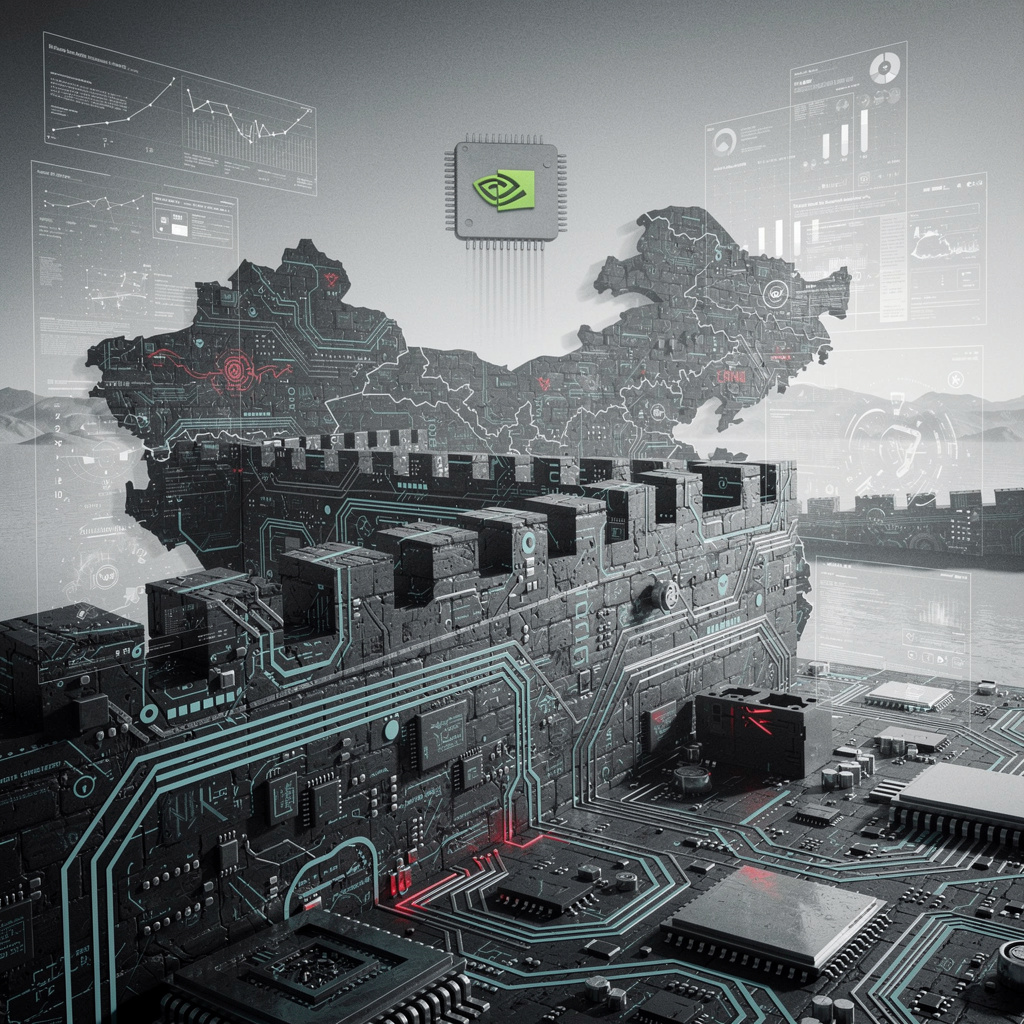
Why China's AI Chip Strategy Is Shifting Away From Nvidia
Chinese authorities are actively discouraging domestic companies from purchasing Nvidia's H200 AI chips despite potential regulatory approval, signaling a strategic pivot toward semiconductor self-reliance. Influential semiconductor expert Wei Shaojun has warned of export control risks and unfavorable commercial terms, while Beijing simultaneously promotes indigenous alternatives and scrutinizes foreign technology for security vulnerabilities. This shift reflects a broader effort to reduce technological dependencies and establish a domestically-driven AI chip ecosystem.
Sources
- https://www.scmp.com/tech/tech-war/article/3339186/tech-war-china-semiconductor-expert-suggests-vigilance-buying-nvidias-h200-ai-chips
- https://www.globaltimes.cn/page/202601/1352885.shtml
- https://longbridge.com/en/news/271913816
- https://www.reuters.com/world/china/china-asks-tech-firms-halt-orders-nvidias-h200-chips-information-reports-2026-01-07/
- https://ai-daily.news/articles/alibaba-stock-surges-on-chinas-potential-approval-of-nvidia-