
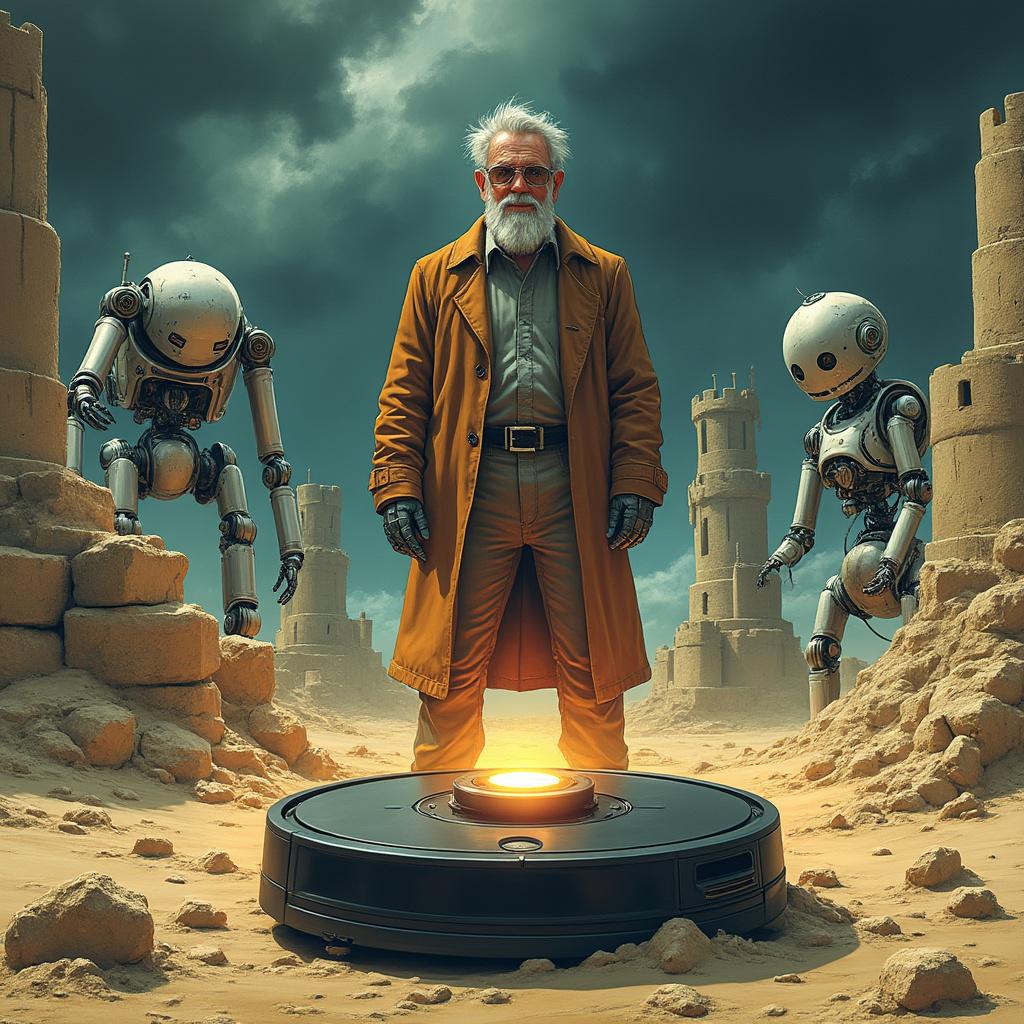
When Rodney Brooks surveys today's robotics landscape, he sees not innovation but delusion. The man who essentially invented modern consumer robotics with the Roomba, which transformed home automation, is sounding an alarm: the industry has lost its way. Given his track record, we should listen.
Brooks' critique emerges at a pivotal moment in tech history amid a humanoid robot fever. Well-funded companies like Figure AI and Tesla's Optimus are racing to build bipedal machines resembling science fiction. Yet Brooks, former director of MIT's Computer Science and Artificial Intelligence Laboratory and iRobot co-founder, contends this direction is fundamentally misguided—a hype-fueled fantasy detached from engineering reality.
The Godfather Speaks: A Career Built on Practicality
Brooks' criticism carries weight due to his achievements. In 1990, he co-founded iRobot, launching the Roomba in 2002—a disc-shaped vacuum that autonomously cleaned floors. It wasn't flashy or Hollywood-esque, but it worked, solved a real problem, and birthed a new market.
His philosophy, honed at MIT, emphasized "embodied intelligence" and "behavior-based robotics." Instead of complex AI planning every move, he favored simple, robust systems reacting in real-time to their environment. The Roomba exemplified this: it bumped into obstacles, adapted, and cleaned without mapping the room—elegant, practical, and scalable.
Now, Brooks applies this contrarian lens to the robotics boom, concluding the industry has forsaken these proven principles.
The Humanoid Trap: Form Over Function
Brooks' core argument is straightforward: the humanoid obsession stems from flawed assumptions about robotic form and function. Companies and investors assume human shape equals versatility. Brooks negates this.
"I like to look at what everyone is doing, find some common thing that they're all assuming implicitly, and negate that thing," he told The New York Times' Nicholas Thompson. This mindset fueled his success, yet today's roboticists have abandoned it.
The humanoid craze misunderstands robotics' value. Human form evolved over millions of years for human tasks, saddling robots with anatomical inefficiencies minus evolutionary adaptability.
Consider task-specific alternatives: optimized for one job, they offer superior performance, cost, and reliability over generalist humanoids. Yet they attract less venture capital and fewer headlines than humanoid helpers.
The Hype-Reality Gap in Modern Robotics
Brooks' views resonate across the robotics community, where experts echo calls to prioritize real problems over flashy tools. This consensus reveals a disconnect between industry hype and practical needs.
The 2025 humanoid funding boom mirrors tech's hype cycles in AI and blockchain, where demos dazzle but utility lags. Impressive walking and gesturing obscure a key question: what problem does this solve better than alternatives?
Brooks, an insider who built iRobot's success on real solutions, lends urgency to this critique.
Lessons from the Roomba: Simplicity and Specificity
The Roomba succeeded through reliability, affordability, and focus on floor cleaning—not sophistication. Its genius lay in clear purpose.
Brooks envisions robotics' future in specialized machines: warehouse bots needn't mimic humans, nor do manufacturing or farm robots. Humanoid assumptions impose needless constraints.
This could yield specialized solutions excelling at niche tasks—less sci-fi allure, more economic value.
The Broader Context: Learning from AI's Mistakes
As 2025 closes, tech reckons with AI failures from hype over utility. Robotics risks the same, but with costlier, more visible flops: millions wasted on unviable humanoids.
Conclusion: A Wake-Up Call for the Industry
Brooks doesn't dismiss humanoid robots outright but urges prioritizing problems over form. His voice, amplified online and in tech forums, fuels skepticism about whether these investments drive innovation or hype.
Humanoids are feasible, but are they optimal? Brooks' career proves transformative robotics solves real problems elegantly.
As capital tightens, task-focused firms will outlast fashion-driven ones. The Godfather of robotics has spoken—whether the industry listens will shape the next decade's success or setback.